
Introduction
Welcome to the exciting world of science! This book is filled with fun and easy experiments that you can do at home with everyday materials. Science is all about curiosity and discovery, and with these experiments, you’ll learn amazing things about the world around you. Get ready to explore, experiment, and have lots of fun!
Experiment 1: Magic Milk
Why is this fun?
This experiment creates a beautiful swirl of colours in milk. It’s like making an instant painting with science! You’ll see how soap and milk interact in a surprising way.
What You Need:
- A shallow plate or bowl
- Whole milk
- Food colouring (different colours)
- Dish soap
- Cotton swabs
Steps:
- Pour some milk into a shallow plate, covering the bottom.
- Add a few drops of different food colouring into the milk.
- Dip a cotton swab in dish soap.
- Touch the cotton swab to the milk and watch the colours swirl!
What’s Happening?
Milk contains fat, and when soap is added, it breaks the fat apart. This movement causes the food colouring to swirl around in a mesmerizing pattern. This is the same reason soap is great at cleaning greasy dishes!
Experiment 2: Baking Soda Volcano
Why is this fun?
This is a mini-explosion right in your kitchen! Watch as your homemade volcano erupts with bubbling lava.
What You Need:
- A small plastic cup or bottle
- Baking soda
- Vinegar
- Dish soap (optional)
- Red food colouring (optional)
- A tray or plate to catch the mess
Steps:
- Place your cup on a tray.
- Fill the cup halfway with baking soda.
- Add a few drops of dish soap and food colouring.
- Pour vinegar into the cup and watch the eruption!
What’s Happening?
Baking soda is a base, and vinegar is an acid. When mixed, they create carbon dioxide gas, which makes the foamy explosion. This is similar to how real volcanoes erupt with gases and lava!
Experiment 3: Walking Water Rainbow
Why is this fun?
You can create a rainbow using just water and paper towels! Watch how colours move from one glass to another.
What You Need:
- 6 clear cups
- Water
- Food colouring (red, yellow, and blue)
- Paper towels
Steps:
- Line up the cups and fill every other cup with water.
- Add red, yellow, and blue food colouring to the water-filled cups.
- Fold paper towels into strips and place one end in a coloured cup and the other in an empty cup.
- Watch as the colours “walk” and mix!
What’s Happening?
The water moves through the paper towel using capillary action, the same way plants draw water from their roots!
Experiment 4: Homemade Lava Lamp
Introduction:
Creating a homemade lava lamp demonstrates the concept of density and the interaction between oil and water. Kids will enjoy watching the colourful blobs move up and down in the container.
Materials Needed:
- A clear plastic bottle or glass jar
- Water
- Vegetable oil
- Food colouring
- Alka-Seltzer tablets
Instructions:
- Fill the bottle or jar about one-quarter full with water.
- Add a few drops of food colouring to the water.
- Fill the rest of the container with vegetable oil, leaving some space at the top.
- Break an Alka-Seltzer tablet into pieces and drop one piece into the container.
- Observe the reaction and add more tablet pieces as desired.
Scientific Explanation:
Oil and water do not mix due to their different densities and molecular structures. The Alka-Seltzer reacts with the water to produce carbon dioxide gas, which attaches to the coloured water droplets, causing them to rise through the oil. When the gas escapes, the water droplets sink back down, creating a lava lamp effect. This demonstrates principles of density and chemical reactions.
Experiment 5: Balloon Rocket
Introduction:
Have you ever wondered how rockets shoot into space? With this experiment, you can launch your own mini-rocket using just a balloon and a piece of string! This fun activity demonstrates how air pressure and thrust work to create motion—just like real rockets.
Materials Needed:
- A long piece of string (about 2–3 meters)
- A balloon
- A straw
- Tape
- Two chairs (or another way to secure the string)
Step-by-Step Guide:
- Tie one end of the string to a chair or other stable object.
- Thread the other end of the string through a straw.
- Stretch the string tightly and secure the other end to another chair.
- Blow up a balloon but don’t tie it—just pinch the end to keep the air inside.
- Tape the balloon to the straw.
- Let go of the balloon and watch it zoom across the string!
What’s Happening?
When you release the balloon, the air rushes out, creating a force called thrust, which pushes the balloon forward. This is the same principle that rockets use to launch into space!
Experiment 6: Ice Fishing with String
Introduction:
Can you lift an ice cube out of a glass of water using just a piece of string? It sounds impossible, but with a little bit of science (and salt!), you can! This experiment shows how salt affects the freezing point of ice, a concept used in winter road safety and food preservation.
Materials Needed:
- A glass of water
- Ice cubes
- Table salt
- A piece of string (about 10 cm long)
Step-by-Step Guide:
- Fill a glass with water and add an ice cube.
- Place the string on top of the ice cube.
- Sprinkle a little salt over the ice and string.
- Wait for about 30 seconds, then gently lift the string— the ice cube should come up with it!
What’s Happening?
Salt lowers the freezing point of ice, briefly melting the surface. As the water refreezes, the string gets stuck to the ice, allowing you to lift it. This process is used to melt ice on roads in winter!
Experiment 7: Dancing Raisins
Introduction:
Can raisins dance? With this fizzy experiment, they can! By adding raisins to a glass of soda or sparkling water, you’ll see them move up and down like they’re dancing. This happens due to carbon dioxide bubbles forming on the raisins, making them float and sink repeatedly.
Materials Needed:
- A clear glass
- Carbonated water or a clear fizzy soda (like Sprite)
- A handful of raisins
Step-by-Step Guide:
- Fill a glass with carbonated water or soda.
- Drop a few raisins into the glass.
- Watch as the raisins sink, then rise back up, then sink again!
What’s Happening?
The soda releases tiny bubbles of carbon dioxide, which stick to the raisins. When enough bubbles form, they lift the raisin to the surface. Once the bubbles pop, the raisin sinks again. This cycle continues, making the raisins “dance.”
Experiment 8: Invisible Ink with Lemon Juice
Introduction:
Want to write a secret message that only appears when you heat it? This experiment shows how lemon juice can act as invisible ink, revealing hidden writing when warmed up. Spies used similar tricks in history to send secret messages!
Materials Needed:
- Lemon juice
- A cotton swab or paintbrush
- White paper
- A heat source (a hairdryer or an adult’s help with a candle)
Step-by-Step Guide:
- Dip the cotton swab in lemon juice and use it to write a message on the paper.
- Let the paper dry completely.
- Gently heat the paper using a hairdryer (or hold it near a warm lightbulb).
- Watch as the hidden message appears!
What’s Happening?
Lemon juice is slightly acidic and weakens the paper fibres. When heated, the juice oxidizes and turns brown before the rest of the paper, making the message visible.
Experiment 9: Static Electricity Butterfly
Introduction:
Did you know you can make a paper butterfly’s wings flap without touching them? Using static electricity, you can move objects just by rubbing a balloon! This experiment demonstrates the power of electrical charges.
Materials Needed:
- Tissue paper or thin paper
- Cardboard
- A balloon
- Scissors
- Tape
Step-by-Step Guide:
- Cut a butterfly shape out of tissue paper and tape it lightly onto a small piece of cardboard, leaving the wings free.
- Inflate a balloon and tie it.
- Rub the balloon on your hair or a wool sweater for 10 seconds.
- Hold the balloon near the butterfly’s wings—watch them move as if they’re flapping!
What’s Happening?
Rubbing the balloon transfers electrons, giving it a negative charge. The tissue paper has a neutral charge, so the attraction causes the wings to move. This is how static electricity works!
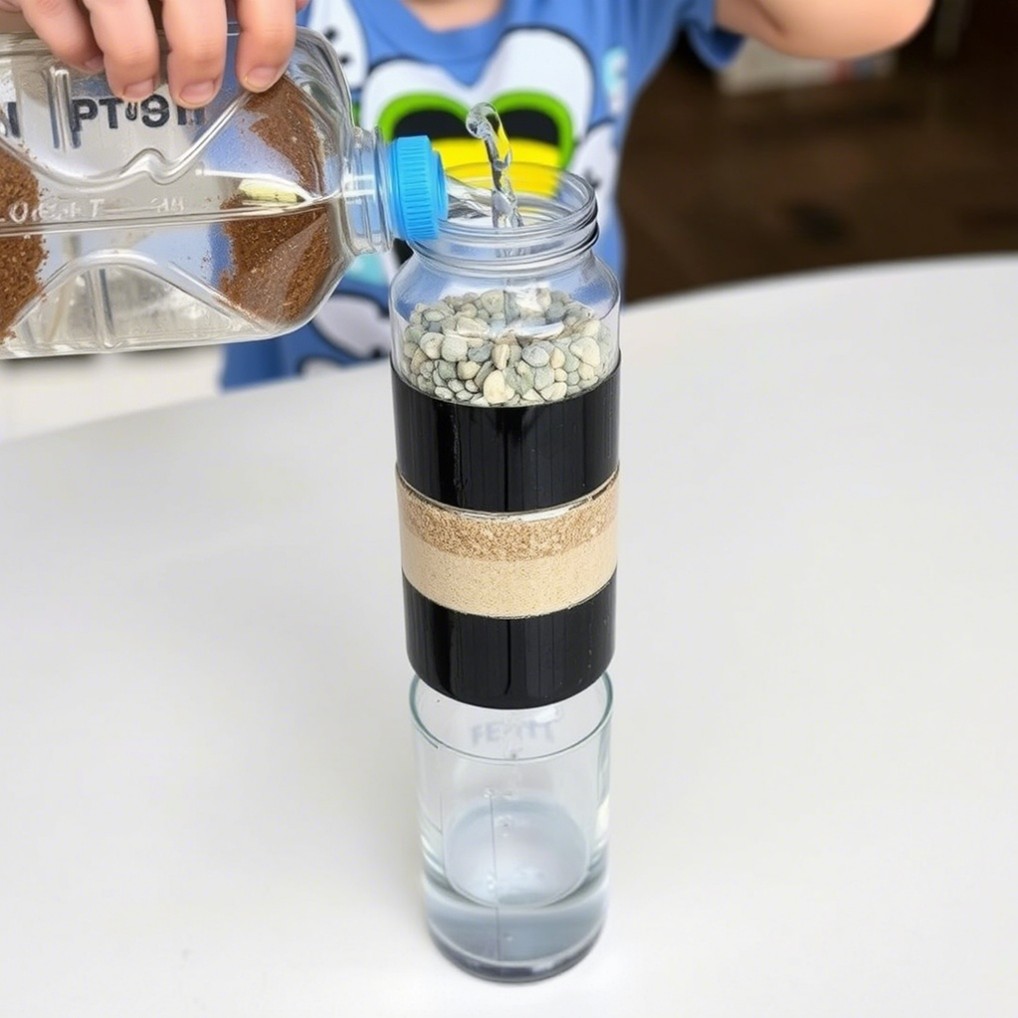
Experiment 10: Homemade Water Filter
Introduction:
Can you turn dirty water into clean water? In this experiment, you’ll create a simple water filter using materials like sand and charcoal. This demonstrates how filtration works to clean water, just like real-life water treatment plants!
Materials Needed:
- A plastic bottle (cut in half)
- Coffee filter or cloth
- Sand
- Activated charcoal (from an aquarium store)
- Small gravel or pebbles
- A cup of dirty water (with soil and small particles)
Step-by-Step Guide:
- Turn the top half of the plastic bottle upside down and place a coffee filter or cloth at the bottom.
- Add a layer of charcoal, then a layer of sand, then a layer of gravel.
- Pour the dirty water through the top of the bottle and watch as clean water drips out the bottom!
What’s Happening?
Each layer traps different impurities:
- Gravel removes large particles.
- Sand catches finer dirt.
- Charcoal absorbs contaminants and odours.
This is how real water filters work to provide clean drinking water.
Conclusion
Science is all around us! With these experiments, you’ve learned about chemistry, physics, and biology in a fun and hands-on way. Keep exploring and discovering new things!
